Why You Understand German but Can't Speak It (And How to Fix It)
You understand German but can’t speak it because recognition and retrieval are two separate skills, and most study methods train only the first. Reading, listening, and app exercises build understanding quickly; speaking requires you to produce the language in real time, which demands its own practice. Close the gap by switching part of your study to active output — sentence chunks, shadowing, and structured speaking.
TL;DR
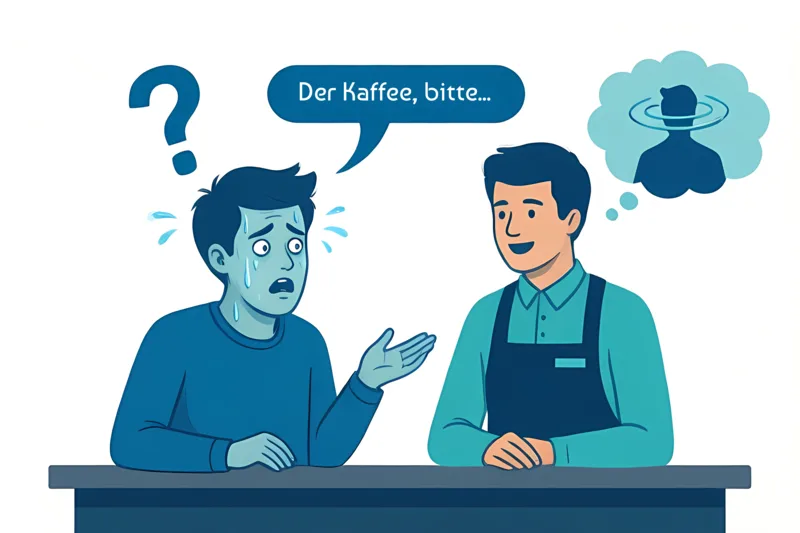
It is the sentence I hear more than any other in fifteen years of teaching — usually from students who have done everything right. They completed the coursebook. They finished the app streak. They understand podcasts and can read the newspaper with a dictionary. And then a waiter in Berlin asks them something simple, and their mind goes blank.
If that is you, I have good news: you are not failing, and you are not bad at languages. You have hit the fluency gap — the distance between understanding German and producing it. It happens to nearly every adult learner, and it is fixable. This article explains exactly why it happens and gives you the method I use with my own students to close it.
What the fluency gap actually is
Understanding and speaking are not two halves of one skill. They are two different skills that grow at different speeds.
Understanding is based on recognition. Your brain hears or reads German, matches it to patterns you already know, and fills gaps with context. Recognition improves steadily with input — podcasts, videos, reading, app exercises. That is why your comprehension can get genuinely good even if you have never said a word out loud.
Speaking is based on retrieval. You have to build those patterns yourself, in the right order, in real time, with no external structure to lean on. Retrieval is trained by exactly one activity: producing the language. And most study methods give you almost none of it.
So your German is not broken. Your understanding has simply been trained far more than your speaking. The best way to learn German from home I recommend combines three pillars — structure, immersion, and output — precisely because output is the pillar most learners quietly skip.
Why you understand German but can’t speak it: the four causes
In my experience, the gap almost always comes from one of these four patterns. See which ones you recognize.
1. Your study time is nearly all passive input
Apps like Duolingo, Babbel, and Busuu are brilliant at one thing: turning learning into a daily habit. They are also recognition machines. You read, you tap, you match — and the moment you need to form a German sentence under pressure, there is no system in your brain that has been trained to do it.
This is not an attack on apps. I recommend them as a supplement to nearly every student. But recognition rising while production stalls is the single most common pattern I see, and it is built into the design.
2. Grammar charts give you knowledge, not speed
German attracts analytical learners — the cases, the word order, the endings invite you to study them like a system. And studying them feels productive. You memorize the accusative table, you run twenty exercises, and you feel you have accomplished something real.
Research on second language acquisition makes an important distinction here: declarative knowledge (knowing about the language) versus procedural knowledge (being able to use it automatically). Memorizing case tables builds declarative knowledge. Real conversations require procedural knowledge, and that only comes from practice under conversational conditions.
In real time, nobody can run the full checklist — is this a direct object, what case does this preposition take, which adjective ending — before every noun phrase. By the time you finish the checklist, the conversation has moved on. That is why the tables do not show up when you need them.
3. The “good student” paradox: over-monitoring
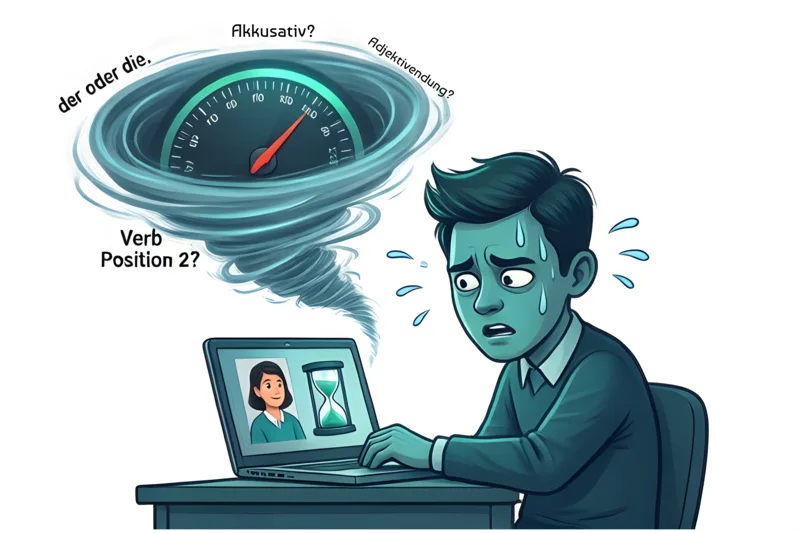
The better you get at understanding German, the more your brain treats it as a puzzle to solve rather than a thing to say. Before you speak, you check: der or die? accusative or dative? verb in position two? Correctness becomes more important than communication.
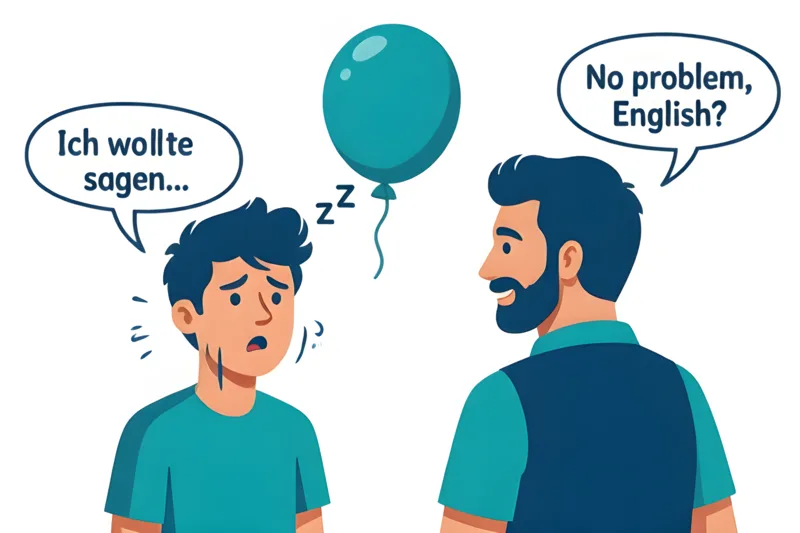
Here is the trap: saying something slightly wrong starts to feel worse than saying nothing at all. So you hesitate, the moment passes, and the other person politely switches to English. That confirms the fear, and the cycle deepens. What looks like a lack of German is often a surplus of monitoring.
4. Fear and the freeze response
Foreign language anxiety is real, and it is physiological. When you fear being judged, your working memory literally shrinks — which means the exact words and rules you studied become harder to access. The anxiety peaks at intermediate levels, when you know enough German to hear every mistake you make.
And there is a specifically German version of this: in Germany, Austria, and Switzerland, people switch to English to be helpful. Every time that happens, you lose the chance to push a sentence out of your mouth. Friendly, efficient, and quietly devastating for your speaking practice.
The good news: it is not a talent problem
I want to be very clear about one thing. The fluency gap is not evidence that you lack a “gift for languages.” The US State Department classifies German as a Category II language for English speakers — roughly 750 hours of classroom time for professional proficiency, squarely in the middle of the difficulty scale, nowhere near the hardest languages. The difficulty is real but bounded. What separates students who speak from students who stall is rarely talent. It is which skills they trained.
Your comprehension is already ahead — that is an asset, not a problem. You have the raw material. You simply need to convert it into retrievable, speakable German.
How to close the gap: the output method
Here is the method I give my students. You do not need to overhaul your life — you need to shift at least 20 percent of your weekly German time from input to output.
1. Speak from day one — imperfectly
Stop waiting until your grammar is clean enough to speak. That day never comes, because the grammar does not get clean from studying — it gets clean from speaking. Accept that your first hundred sentences will be ugly. Mine were. Every student’s were.
The students who break through the fastest are almost never the ones who studied the most. They are the ones who made the most mistakes and kept going anyway.
2. Learn sentence chunks, not just words and rules
This is the single most effective technique I know. Instead of memorizing isolated rules, memorize ready-made sentence frames that carry meaning and structure together:
- Ich glaube, dass … (I believe that …)
- Kannst du mir sagen, ob … (Can you tell me if …)
- Gestern bin ich … (Yesterday I …)
- Ich wollte nur kurz … (I just wanted to quickly …)
Chunks are powerful for one reason: they reduce decision-making. When half your sentence is pre-assembled, you do not have to run the checklist on it. You save your working memory for the part that is actually new. Research shows sentence frames build automaticity faster than applying rules in real time.
3. Shadow every day — even ten minutes works
Shadowing means playing a short clip of natural German — ten to thirty seconds — and repeating it aloud along with the recording, copying not just the words but the rhythm, pauses, and intonation. Start with slow, clear content like Deutsche Welle’s Langsam gesprochene Nachrichten (slow-spoken news), then work up to normal speed.
Many students who have been stuck at a plateau for months find that fifteen minutes of daily shadowing produces noticeable results within three to four weeks. It trains your mouth to move at native speed before your conscious mind has time to interfere.
4. Keep your input slightly above your level
The other side of the equation is still input — but the right input. Textbooks are often too clean and artificial; native news is often too fast. The sweet spot is comprehensible input where you understand roughly 80 percent, with the rest guessable from context.
Also: when you listen, do not pause to look up every unknown word. Listen through the whole segment first, note what you understood, then go back. Building tolerance for ambiguity is itself a speaking skill — real conversations are full of words you do not fully know.
5. Get corrected by a human, on purpose
Self-study has one fatal weakness: it embeds your errors as readily as it corrects them. No app tells you that the way you pronounce der is why people look confused, or that you have been fossilizing the same dative mistake for three months.
At a certain point you stop noticing your own errors — linguists call this fossilization, when communication works well enough that nothing forces you to fix the mistake. The cure is deliberate feedback from a native speaker who points out the two or three errors that actually matter, over and over, until they are gone.
Passive methods vs. active methods
Here is the honest comparison of what builds what:
| Method | Builds | Speed of speaking payoff |
|---|---|---|
| App streaks (Duolingo, Babbel) | Vocabulary, habit | Almost none |
| Podcasts, TV, reading | Comprehension | Low |
| Grammar tables + exercises | Declarative knowledge | Low |
| Journaling in German | Writing retrieval | Medium |
| Shadowing | Pronunciation, rhythm, automaticity | High |
| Sentence-chunk drilling | Automatic speech | High |
| Speaking with a teacher / small group | All of the above, with correction | Highest |
Notice the pattern: the methods that build speaking fastest are the ones where you produce the language, and the best of them involve another person. That is not a coincidence — it is how retrieval gets trained.
A realistic timeline
Be patient with yourself, and be precise about what you are measuring:
| Timeframe | What you can realistically expect |
|---|---|
| Weeks 1–2 | You will feel more awkward before you feel better — normal |
| Weeks 3–4 | Sentences start arriving faster; fewer blank moments |
| Weeks 5–8 | You recover from mistakes mid-sentence instead of freezing |
| Months 3–6 | Simple conversations flow; the gap narrows to a normal, human pause |
You will notice the gap never fully disappears — even advanced speakers search for words. That is not failure. Fluency is not perfection; it is the ability to stay in the conversation while making mistakes. Aim for continuity, not polish.
The fastest fix: speak with a person every week
Every method above is a bridge, but the bridge gets shorter when you practice with a real human who is there to let you speak. That is the difference between practicing speaking and being expected to speak.
This is exactly why I run my group course in small groups of maximum six students. Six is the number that lets everyone talk every single session — enough people to feel like a real class, few enough that nobody hides in the back. We speak from minute one, I correct the mistakes that actually block you, and the other students give you the kind of low-stakes practice where making errors is normal.
If private, one-on-one practice fits your schedule or level better, my 1:1 online lessons are built around the same principle: you speak, I correct, we keep going.
The first group lesson doubles as your free trial — you decide whether to continue only after you have experienced it. There is nothing to lose but a session of real speaking practice.
Frequently Asked Questions
Why do I understand German but can’t speak it? Because understanding (recognition) and speaking (retrieval) are different skills, trained by different activities. Input builds understanding; only output builds speaking. The gap is normal, not a talent problem.
How long does it take to fix the fluency gap? With at least 20 percent of your study time spent speaking, most learners feel real improvement within 4–6 weeks. It never disappears entirely — it just shrinks to a normal human pause.
Do apps help you speak German? They build vocabulary and habit, but they do not train real-time production. Use them as a supplement; practice speaking separately, ideally with a person.
I have nobody to talk to — what do I do? Shadowing, talking to yourself, and voice messages all help. The fastest fix is a teacher or small group where speaking is expected every session.
Why do I freeze when someone speaks to me? Your brain is over-monitoring — running a correctness checklist instead of communicating. Drilling sentence chunks and making mistakes in a low-stakes setting lowers the freeze.
Do I need perfect grammar before I can speak? No. Perfect grammar comes from speaking, not before it. Start speaking imperfectly and let correction do the work.
The fastest way to close the fluency gap is to speak every single week. In my small group course (max 6 students) you talk from the first minute, get corrected live, and make mistakes safely — and the first lesson doubles as your free trial, so you only continue if it works for you.
Join the Small Group Course